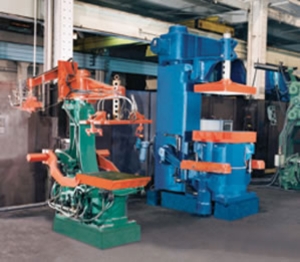
Questioning Tabletop Molding Machines for Production Foundries
Foundry leaders are under pressure to do more with less. Labor is tight, lead times are shrinking, and seasonal demand hits hard in the fall when the weather cools and orders spike. It is no surprise many teams are looking at a small tabletop molding machine as a fast way to add capacity without a big layout change.
The real question is simple: can a tabletop molding machine truly carry production work, or is it better as a support tool on the side? At EMI, we design and build molding equipment and automation for foundries of all sizes, so we see both the promise and the limits of small-format systems. In this article, we will walk through where tabletop molding fits, where it falls short, and how to think about long-term molding capacity as your foundry grows.
Rethinking Small-Footprint Molding for Real Production
Many production foundries see a bench or tabletop unit and think, “That could solve our backlog before the fall rush.” A compact machine feels flexible, quick to set, and easy to tuck into an open corner of the floor.
But there is a big difference between building a few test molds and feeding a steady production schedule. The demands from automotive, heavy equipment, and industrial customers call for consistency, uptime, and repeatable output, shift after shift.
When we look at molding choices, we like to frame it around four simple questions:
- How many good molds per hour do you really need?
- What kind of mix and complexity are you running?
- How steady does your quality need to be?
- How much growth do you expect over the next few years?
From there, it becomes clear very quickly if a tabletop solution is a main production answer or a side tool.
What Tabletop Molding Machines Really Deliver
A tabletop molding machine is usually:
- Small footprint, often on a bench or stand
- Lower tonnage squeeze or compaction
- Limited flask size and mold height
- Semi-manual, with hand operations between steps
These features can be helpful. Many foundries use this kind of equipment for:
- Prototype castings
- Short experimental runs
- New pattern validation
- Training new operators
- Work in technical or educational centers
The main appeal is clear: minimal floor space, simple installation, and a feeling of fast setup for small jobs. When the calendar points toward busy months, it can look like an easy way to catch up.
But these machines are usually not built for continuous, multi-shift foundry work. They are not meant to live in harsh sand, metal, and vibration day after day as the primary line. If you try to turn them into full production, the tradeoffs start to show up in speed, quality, and maintenance.
Throughput, Quality, and Uptime in a Production Reality
When we compare tabletop units to production molding lines, three things stand out: throughput, quality consistency, and uptime.
Throughput is limited by:
- Flask size and mold volume
- Cycle time for each mold
- How many manual steps an operator must perform
On a tabletop molding machine, the operator often handles sand filling, strike-off, and mold handling by hand. Output then depends on skill, speed, and fatigue. Automated molding lines, on the other hand, are designed to run at a steady pace, hour after hour, with less variation between molds.
Quality can also shift more on a small unit. Manual filling and ramming affect:
- Mold hardness
- Sand consistency from mold to mold
- Dimensional repeatability
- Defect rates on tight-tolerance parts
This matters when you have complex geometries, tight dimensions, or demanding customers. Small swings in compaction or surface finish can lead to more grinding, rework, or scrap.
Uptime is another concern. Light-duty tabletop machines are usually not engineered for constant heavy use in abrasive sand environments. In a real production setting, that can mean:
- More frequent adjustments
- Shorter service intervals
- Unplanned downtime during busy seasons
When fourth-quarter orders pick up and schedules tighten, a machine that is “good enough for test work” may turn into a bottleneck. At that point, overtime grows, rework piles up, and lead times stretch, which undercuts the reason you added capacity in the first place.
The True Cost of “Low-Cost” Bench Molding
A lower purchase price is attractive, but it does not tell the full story. Total cost of ownership includes:
- Maintenance and repair
- Spare parts and service time
- Scrap and rework
- Energy and air use
- Floor space that could support higher output equipment
Labor is a big part of this. Tabletop molding machines often demand highly engaged operators for sand filling, strike-off, core setting, and lifting or rotating molds. That brings questions about:
- Ergonomics and strain over a long shift
- Training time for each new hire
- Exposure to injury risk in tight workspaces
In a tight labor market, relying on intense manual work can make it hard to grow or cover all shifts.
Scalability is another hidden cost. Once you set up a bench area, run utilities, and build job routines around it, changing later to a larger automated system can be disruptive and expensive. The early “easy win” can lock you into a process that hits its ceiling fast.
There is also the opportunity cost. When a job that could run on an automated molding system is instead pushed through a low-throughput bench machine, you may be giving up:
- Shorter lead times on larger programs
- Room to accept rush work or seasonal contracts
- Flexibility to reshuffle schedules when customers change forecast
Those missed chances can have a bigger impact than the original equipment cost.
When a Tabletop Molding Machine Makes Sense
None of this means tabletop molding has no place in a production foundry. It simply means we use it where it fits best.
Smart uses include:
- R&D labs and pilot lines
- Pattern development and tryout
- Very low-volume legacy parts
- Special alloys or process trials where you do not want to interrupt a main line
These are areas where flexibility beats speed, and where you learn and tweak before committing to bigger runs.
Tabletop systems are also great for training. New operators, engineers, and maintenance staff can see the molding process up close without tying up a production machine. They can practice sand handling, pattern care, and best practices in a slower, more controlled setting.
Hybrid layouts can work very well. Many plants benefit from:
- High-volume, repeat work on automated molding lines
- Small projects, development work, and trials on tabletop or semi-manual cells
In this model, the tabletop molding machine supports the plant, but it does not carry the plant. When fall and year-end demand hits, it plays a backup role instead of being the primary plan.
Charting a Smarter Path to Automated Molding Capacity
When you step back from the “cheapest machine” mindset, the choice becomes clearer. The better question is: what performance do you really need from your molding area?
Key points to define include:
- Required molds per hour across your part mix
- Typical and peak demand over the year
- Quality targets and defect tolerance
- Space, staffing, and expansion plans
Once those are clear, it becomes easier to compare a tabletop molding machine with production-grade equipment and automation. At EMI, we design molding and automation systems that can grow with a foundry, from more manual cells to highly automated lines that tie molding, core production, and finishing into a single flow.
A structured assessment of your casting mix, production schedule, and current equipment can reveal where a tabletop unit fits as a support tool and where higher-capacity automated molding makes more sense. When that plan is in place, you are better prepared not only for the next busy season, but also for the long-term growth of your foundry.
Get More Control Over Your Molding Projects Today
If you are ready to improve consistency and precision in a compact footprint, our tabletop molding machine is designed to fit your workflow. At EMI, we work with you to match your application requirements with the right configuration so you can get reliable results from day one. Tell us about your project and we will help you evaluate options, timelines, and next steps. Have questions or need a quote quickly? Contact us and our team will respond promptly.