CASE STUDY:
FALL RIVER FOUNDRY EXPANSION
By Jerry Senk, President of Equipment Manufacturers International, Inc.
ARTICLE TAKEAWAYS:
- Expansion includes automatic match plate system to meet production& safety goals
- Robust custom design enhancements for longevity
BACKGROUND
Fall River is a private, family-owned foundry that started in Wisconsin in 1953.They have a proven track record and have excelled in brass, bronze, andaluminum castings in a green sand production foundry. It is a truly first-inclass,vertically integrated foundry that can provide complete machined andassembled products.EMI has had the opportunity to work with and support Fall River with foundryequipment, parts, and services for many years. This foundry is well-kept, wellmaintained,and internally supported by a very talented team of employees.Besides their manual molding machines, which feature Osborn equipment,they also have a very well-maintained Herman tight flask line. EMI’s firstproject was a decade ago, when we supplied a new EMI 1419 match plate moldmachine with a mold-handling, pouring, and cooling line.
FOUNDRY EXPANSION
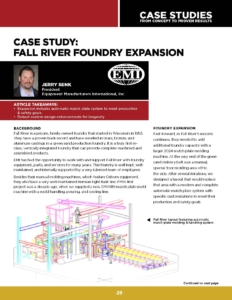
Fast forward, as Fall River’s successcontinues, they needed to addadditional foundry capacity with alarger 2024 match plate moldingmachine. At the very end of the greensand delivery belt was a manual,special floor molding area off tothe side. After several iterations, wedesigned a layout that would replacethat area with a modern and completeautomatic match plate system withspecific customizations to meet theirproduction and safety goals.
KEY CHALLENGES
- We had to work around a very large electrical panel (read: “non-movable”), pick up enough sand to feed thesystem, and still avoid inhibiting the return sand.
- The height was critical to fitting a machine under the belt without a pit.
- The location and orientation of the machine was in close proximity to an Osborn 3191 RJW, and required aunique casting plow off solution, a specially designed lump buster, and a way to get the molds into the system
- Floor space was at a premium, and the panel location as well as the power unit location were notably remotecompared to a typical installation.
- Required an upper deck to provide access to the sand storage silo as well as the elevated main power unit thatserviced the machine and the mold-handling system.
- Floor-mounted HMI stations, on-unit J-box locations, remote I/O valve stands, and specially designed wiringharnesses for installation were all designed specifically for this system.
- Due to limited floor space, many of the hydraulic, electrical, and pneumatic runs were mounted on the units forease of installation as well as future accessibility.
PROJECT GOALS
- Focus on safe guarding workersLight curtains around the machine,fixed guarding, and barrier guardingwere all coupled through a safetyPLC. Fall River was especiallyproficient in providing guidanceand input in these important areas.
- MaintenanceA completely automatic heavy-dutysystem with straightforward designthat would be easy to maintain.
- Automatic SystemIncreasing foundry capacity to60-70 molds per hour.
- Mold ProductionHigher quality mold productionincluding excellent compactabilityfor close-to-the-edge patterns.
DESIGN IMPROVEMENTS
- Hardened chrome guide rods withreplaceable Pacific bearings thatrequire no lubrication
- Fixed roller bars for stripping ofthe drag flask and mold• LVDT’s for both the cope anddrag positions
- Heavy-duty cope strip cylinders,providing additional head room forcore setting• Rotary actuator design for the rollover with mid position for operatorinterface with the drag flask, ifrequired
- Vee-shaped hardened roll over ringsitting atop Vee rollers to eliminatesand abrasion
- New fork-type bottom boarddelivery system to assure even andaccurate board placement in thedrag every time• External bottom board cassettestorage to minimize the numberof boards to lift
- Pressure-compensating hydraulicclosing system with drag and copecylinders to assure a positive closeand strip of the mold halves• Dual bearing support forVFD- controlled aerator shafts forlong lasting, ease of replacement
- Dual rotary measuring hopperlouvers to provide optimum sandfill across the flasks
- Newly designed cope-squeezehead with built in tuck strips forbetter mold quality.
FLOOR & SPACE LIMITATIONS
The installation at Fall River waschallenging—due to floor unevenelevations over the entire productionfloor. To accommodate for this, weprovided at least 1” of variability inelevations using foot pads.Space for mold accumulationbetween the machine and the moldhandlingsystem was also limited.We could fit only about four moldsbetween the mold push-on and themachine’s exit position. To addressthis, we incorporated an elevatedbottom-board return roller conveyor,which created clear access for coresetting on both the back and frontsides.
MOLD HANDLING SYSTEM
The mold-handling system selected can operate with any type of matchplate machine and features a solid, heavy-duty design that is not affected by normal sand buildup. Our pallet cars are castings—not fabrications—and are equipped with replaceable graphite tops. They feature universal shafts and rollers that are bolted from the shaft ends rather than cantilevered. The weights and jackets are also cast, include venting slots, and use moveable topweights to accommodate different sprue locations. The pallet cars run on 40# railroad rails, which are also used on all horizontal-transfer ancillary units, including the weight-and-jacket transfer and the plow-offs.
The weights and jackets are transferred with tapered clamps that center these accurately, with floating links to set smoothly onto the awaiting molds. They have extended pins and reverse-tapered holes on the pallet car tops to ensure no movement when set without molds. We offer weight and jacket cleaning stations that can separate the components and clean independently. The mold plow-off is not just a blade but a complete box with a trailing wiper scraper. This ensures that the mold—carried on a double pallet car—remains fully contained as it moves into adjacent positions. We also added wings on the far side of the pallet cars to contain any sand breakdown after the weight and jacket are removed. Using end-of-the-line transfer cars equipped with the same rails ensures smooth transfer. Pallet car alignment is maintained by large 10-inch-diameterrollers that keep the system precisely on track as it moves between the pouring and cooling lines. This installation took place in a brownfield area of their plant, and all existing operations continued running throughout the process. In additional to managing the installation, Fall River also took a very hands-on approach with the electrical engineering. “Fall River’s commitment to expanding production through modern automation and driving greater efficiency was truly exceptional, and EMI was pleased to work with such a talented team, ”said Jerry Senk, president of EMI.